Preaching Beyond the Pulpit: My Journey with the New Frontiers in Preaching Academy
Written By: Emily Lugo, M.P.S.
Earlier this year, I had the blessing of participating in The New Frontiers in Preaching Academy, a certificate program organized by the Aquinas Institute of Theology. Designed for both deacons and pastoral leaders, the Academy focuses on helping participants integrate scriptural, congregational, and cultural exegesis into the ministry of preaching.
The track I joined was offered in Spanish, with a particular focus on serving Catholic Hispanic communities. My classmates included deacons—many of whom were native English speakers working to strengthen their preaching in Spanish—as well as lay women serving as catechists and ministry leaders in their dioceses. Together, we shared a common desire: to grow in our ability to proclaim the Word of God in a way that is both meaningful and engaging.
Although I have worked in the Catholic Church for nearly 20 years in a variety of ministry roles, homiletics was new territory for me—especially as a lay woman. I was eager to broaden my understanding, not only for my personal growth, but also to better serve in my role as program coordinator at the Institute for Homiletics. I hoped that my own learning journey would allow me to walk more closely with our participants and provide valuable insights into the unique preaching needs of the Hispanic Catholic community.
As Catholics, we often think of preaching as the responsibility of priests or deacons. Yet all the baptized share in Christ’s mission as priest, prophet, and king. We are called to be witnesses through both word and deed, helping bring about God’s Kingdom here on earth. Preaching takes many forms. Of course, it includes the homilies we hear at Mass, but it also happens in everyday life: in a heartfelt conversation at home, at work, in school, or even on the sidelines of a child’s sporting event. In ministry settings, preaching can mean leading a small faith-sharing group, teaching a formation class, or presenting at a parish event. At its heart, preaching is about sharing the encounter with Christ.
The Academy was both enriching and demanding, offering a meaningful blend of theological study, practical application, and spiritual growth. My coursework included theological and liturgical readings, research on my parish community, and the preparation of scriptural reflections. One of the key texts we studied was The Practices of Christian Preaching by Jared Alcántara. This work challenged us to incorporate the “Five C’s” of healthy preaching habits—conviction, context, clarity, creativity, and concreteness—into our preaching assignments.
We also learned the importance of integrating the liturgical seasons and celebrations into homily preparation, ensuring that preaching resonates with the rhythm of the Church year. Because our program emphasized preaching within the Hispanic Catholic community, we explored how culture shapes the way the Gospel is heard and received. A highlight for me was watching a talk by Pope Francis, who reminded us: “La inculturación del Evangelio respeta a los pueblos, no se impone”—“The inculturation of the Gospel respects peoples; it is not imposed.” This reminder reinforced for me that effective preaching across cultural boundaries requires intentionality, respect, and a genuine desire to connect so that the Gospel may be understood, embraced, and ultimately transformative.
One of the most humbling tasks was recording my preaching in Spanish—not my first language—for evaluation by our instructors and classmates. I quickly discovered that preaching is not simply a lecture or catechetical presentation. True preaching breaks open the Word of God and creates space for the Holy Spirit to speak, so that listeners can encounter the living Christ. This was a new and vulnerable experience for me, and it deepened my appreciation for the priests and deacons who stand before us each week to faithfully proclaim the Word.
The program culminated in a graduation prayer service at Aquinas Institute in St. Louis, where I was invited to preach in Spanish. I reflected on John 20:11–18 and the role of Mary Magdalene, the “Apostle to the Apostles.” As the first witness to the Resurrection, she reminds us that preaching begins with encounter. We proclaim not merely ideas or doctrines, but someone we have met—the risen Christ who calls us by name and transforms our lives.
- You can watch that reflection here: Youtube Video
- You can read my reflection on John 20:11-18 in English and Spanish here: “Called to Proclaim”
I left the Academy inspired. Despite my hesitations and doubts, I feel renewed in my call to meet the Lord and share that encounter with others. I am deeply grateful to all clergy who dedicate themselves to improving their preaching so their congregations may draw closer to Christ.
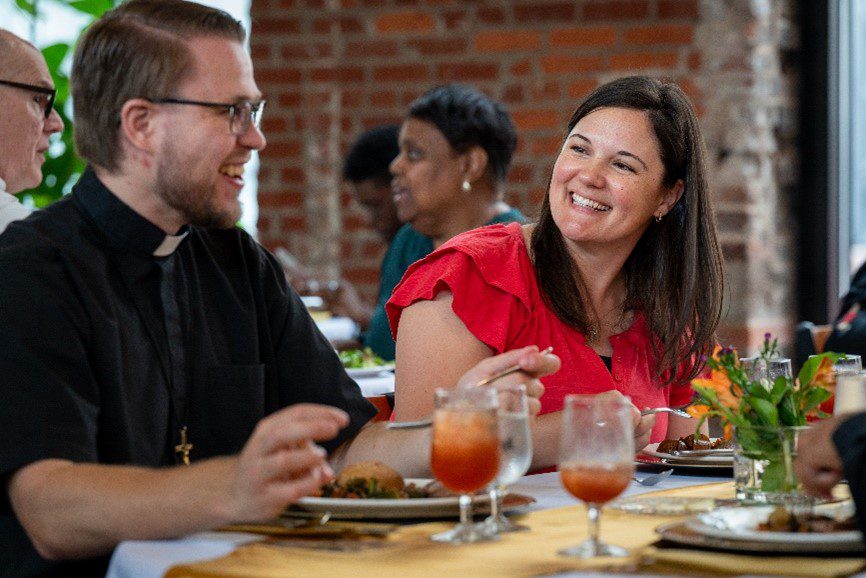
One of my classmates, Mateusz Garstecki (pictured above), entered the program as a transitional deacon with the Oblates of Mary Immaculate. Though a native English speaker, he was invited to preach in Spanish during our graduation Mass—a beautiful example of how God uses us as vessels to bridge cultural differences and build spiritual connections. Mateusz, now recently ordained to the priesthood, begins his ministry with tools to continue honing his preaching skills and confidently proclaiming the Word. My other classmates likewise leave the program better equipped to approach preaching with the seriousness and intentionality it deserves, as part of God’s mission to renew his Church. As St. Paul reminds us: “If I preach the gospel, this is no reason for me to boast, for an obligation has been imposed on me, and woe to me if I do not preach it!” (1 Cor 9:16).
I am especially thankful to Theresa Orozco, who served as the Academy’s coordinator. Her joy, organizational gifts, and leadership brought together a gifted team of instructors and created a transformative experience for all of us.
This journey has reminded me that preaching is not reserved for a select few—it is a call entrusted to every believer. And when we dare to share our encounters with Christ, in whatever setting God places us, the Word becomes alive again.