• Skip to main content
MENUCLOSE

Institute for Homiletics

A Collaboration of The Catholic Foundation and the University of Dallas

  • CONTACT US

ANNOUNCEMENTS

Jun 29 2026

The Preacher as Witness in Ordinary Time

By Dcn. Bill Eckert, Institute for Homiletics Coach:

On the road to Emmaus, two disciples encountered the risen Lord in the breaking of the bread. They immediately took to the road to spread the good news to their community back in Jerusalem.

What a beautiful reminder that every preacher must first be a person of faith—someone who has encountered the risen Lord and continues to encounter Him throughout life.

Their encounter at the table was preceded by their encounter with Jesus on the road… which was preceded by their encounter with Him during his passion and death…
which was preceded by his triumphant entrance into Jerusalem…
which was preceded by months of discipleship on the journey through Galilee, Samaria, and Judea. The point is: their encounter had unfolded over time.

Some of us have encountered Christ in a singular, dramatic moment, like St. Paul on the road to Damascus. Most of us have not—most of us have experienced Him over the course of our lives along the winding roads we’ve traveled. Whether the encounter came in a transforming moment or a series of graced encounters, we are witnesses who are impelled to share our experience and faith with others. That is what it means to be a preacher.

It is no longer the Easter season. Now in Ordinary Time, as preachers, we can witness in a way that reveals that we too are disciples. In homily preparation, we deeply reflect on our own Emmaus journey that leads us into a deeper relationship with the Lord. In the liturgy, we witness in parallel to the disciples on the road to Emmaus: we seek the Lord’s companionship as he opens the scriptures through us and he breaks the bread. Even as we stand before the community as preachers, we also stand with them as disciples seeking understanding and encounter. This is the journey that is always extraordinarily ordinary.

Our communities long to see and hear from witnesses. This is a high calling. While we might hope that they marvel at our learning, it is our faithfulness and conviction that transforms. As a deacon, as I watch someone preach, I ask myself whether I can tell that they know Jesus Christ, not in the intellectual, but in the relational sense. If that knowledge is there and it shows through in their words and demeanor, then I am ‘hooked.’ However, eloquence without conviction, without infused knowledge of the risen Lord, is not enough to move me.

We are called to testify, to be witnesses to the truth of our faith. Pope Leo says that AI cannot do that. In a high-tech world, we do not share ‘hearsay’ but our own eyewitness account of faith, hope, and love. We join Peter and the saints throughout history as witnesses of these things, the things that Jesus said and did that have changed the world (See Acts: 1:8 below). If we are convicted, then we are impelled to share what we know to be true with others.

We, as preachers, are first and foremost, witnesses.
Written by Homiletics Student Worker · Categorized: ANNOUNCEMENTS

Jun 24 2026

Catholic Young Adult Study: Better Homilies Correlate with Stronger Parishes

By Dr. William E. Baker and Dr. Karla J. Bellinger

A friend jokes that she is a “Roamin’ Catholic” – she and her husband and their young family travel around to Catholic parishes in her large city, searching for inspiring preaching. She knows that the focus of Mass isn’t just the preaching. She knows that priests are busy and don’t always have time to prepare their homilies as well as they would like. She has learned that seminaries do not require many homiletics courses and so sometimes training in preaching is suboptimal.

In spite of knowing all of that, she still hungers to hear a homily that engages her children and strengthens their faith as a couple. Preaching matters to her life of faith.

How does the Catholic liturgical homily influence the life of Catholic young adults? That overarching question framed A National Survey of Young Adult Catholic Listeners, a recently published nationally-representative study by the Institute for Homiletics at the University of Dallas. Sponsored by the Lilly Endowment Inc., the study sheds light on the potential impact of liturgical preaching for Catholic young adults aged 18-45.

This article analyses one small segment of that study, looking at the set of questions that asks “How does the quality of the homily affect how a young adult interacts with parish life?” We correlated the responses to the evaluation of the homily (question 20) with the survey questions that reflect a young adult’s relationship with his/her parish: frequency of Mass attendance, engagement with parish activities, and annual household giving.

Anecdotally, every diocese has its stories: an inspiring preacher is assigned to a parish and as a result, so many people come to Mass that the walls are bursting. The parish finances, which had been shaky, become solid. Young people want to hang out at the parish and do things together. Commitment to the broader Church grows. Vocations start to come from those particular parishes. We as a Church – we have seen it happen time after time.

We also have stories of the reverse as well: a so-so preacher replaces an impactful one and
folks gradually… well… start to drift away from the parish. They may (or may not) go elsewhere; they just don’t go to Mass quite so often; they are less engaged in the parish; finances that had been strong… they start to weaken. We as a Church have seen both positive and negative parish outcomes as a result of the quality of the liturgical preaching.

At the Institute for Homiletics, we have also found some powerfully positive news in the data from our young adult study: There is a direct correlation between how a young adult perceives the homily and how he or she interacts with his or her parish. When the homily is “good,” there is greater Mass attendance, more money goes into the collection basket, and more time is spent in parish activities.

Can we statistically say that better homilies cause stronger parishes? No. Given the nature of survey research, a direct causal impact of homilies on parish health is not possible – further qualitative research would be needed to ascertain that causality. But along with hymns and hospitality, the homily is one of the most visible variables in Catholic liturgical practice. The question, “how was Mass?” when a parishioner returns home, often refers to the quality of the homily. From the results explicated below, we can definitively say that the quality of liturgical preaching matters to the faith life of a parish.

Mass Attendance

From the Pew Research Center’s 2023-24 U.S. Religious Landscape Study (RLS), 28% of U.S. Catholics go to Mass weekly. Our study reflected numbers that are similar: of those aged 18-29, 35% are weekly Mass go-ers; of those who are 30-45 years old, 29% attend Mass weekly.

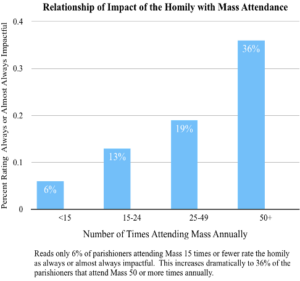
Thirty-six percent (36%) of the young adult weekly Mass attendees rate the homily as always or almost always impactful for them. Mass attendees are six times more likely to say that the homily is impactful than those who come to Mass rarely (less than 15 times per year). Only six percent (6%) of those who come occasionally can say that the homily is always or almost always impactful for them.

Attend Mass

Certainly, for those who are regularly at Mass, one out of three is not as high a rating as we would like it to be. Bishops bemoan the stack of letters on their desks which complain about poor preaching. But it is even more clear that the words from the ambo are not connecting with those “in the back”. (See The Lord Hears the Cry of the Poor: Lament and Evangelization in the Institute’s Homiletic Scholar Series.) Young people grow disheartened when they hear (what they themselves call) the “same-old-same-old” (see the 2012 survey of Catholic teens in Connecting Pulpit and Pew, pg. 13).

Engagement in Parish Activities

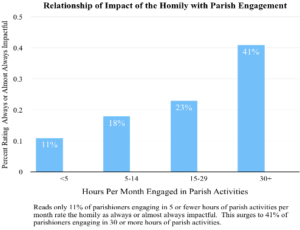
Parishioners who engage in parish activities more than 30 hours per month are four times more likely to rate their homilies highly than those who engage five or fewer hours per month. They are involved in prayer, Mass, retreats, young adult groups, bible studies, and more. A sign of parish flourishing is that young adults want to be there. Those who find the homily impactful are more likely to be at the parish.

Engaged inParish

Giving of Income

Young adults have never historically been the “big givers” in a parish. In our study, when asked what percentage of annual income they contribute, two thirds of them give ten percent or less.

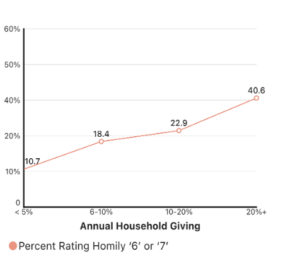
But for young adult parishioners who are positively impacted by the homily, there is a significant difference in how much they put into the collection plate. It is striking: more than forty percent of those who rated the homily highly (a 6 or 7) say that they contribute 20% or more of their annual income to the parish. Another almost 23% give 10-20% of their annual income.

Annual Household Giving

Though the preaching of the Gospel has never been proclaimed for its return on investment (ROI), this correlation would suggest that investment in the improvement of homilies might result in financially healthier balance sheets.

The Vision of Renewal

The Church is concerned about its outreach to youth and young adults and rightly so. Critiques of the homily abound and there is surely room for improvement. Yet we see a population of young adults who, with Pope Francis, have found that “the homily can actually be an intense and happy experience of the Spirit, a consoling encounter with God’s word, a constant source of renewal and growth” (Evangelii Gaudium #136). These young adults who hear effective homilies help their faith communities to flourish: they come to Mass, they are involved in their parishes and they contribute their income to the place that they have grown to love. Impactful homilies are a powerful part of parish health.

Written by Homiletics Student Worker · Categorized: ANNOUNCEMENTS

Jun 16 2026

Feed My Sheep: Two Cistercian Monks Among 26 Priests Join New Cohort At Institute for Homiletics at the University of Dallas

For the third cohort in a row, Cistercian monks are among the priests who know the Word and hunger to give it away.

By Anna Liza Denny

IRVING, Texas (June 12, 2026) — During a recent homily on the Solemnity of Corpus Christi, Fr. Jerónimo Espinosa, M.P.M. ’23, chaplain at the University of Dallas, asked us if we have ever experienced hunger. He then pointed to the void inside us and announced that Jesus is our food. He said that when we say “Amen” every time a priest says “Body of Christ” during Holy Communion, we are affirming our belief: “so be it,” “truly,” “it is true.” His homily stirred the pews. It made clear what so many of us feel but rarely name: we have a God-given hunger. And we cannot wait to be filled by Jesus.

Have you heard a homily lately that fed you?

The Institute for Homiletics’ (IFH) mission is just that: to form priests and deacons who can recognize that hunger, name it and point them straight to the One who satisfies it.

On June 23, the Institute will welcome 26 priests from across the country for its next 20-month Preaching for Encounter Program (PEP) and among them, two Cistercian monks.

Fr. Thomas Esposito, O. Cist., BA ’05, and Fr. Joseph Van House, O. Cist., BA ’03, MTh ’07, are Cistercian monks who teach at the University of Dallas and bring to their classrooms a centuries-old tradition of contemplative prayer and deep immersion in Sacred Scripture.

They are following the footsteps of other Cistercian monks who graduated from PEP cohorts: Fr. Abbot Peter Verhalen, O. Cist., and Fr. Christopher Kalan, O. Cist., in 2022; and Fr. Matthew Hegemann,  O. Cist., B.A. ’15, M.A. ’20, and Fr. Francis Gruber, O. Cist., in 2024.

So why would Cistercian monks and other priests who have extensive knowledge of Scripture sign up for programs organized by the Institute for Homiletics? Could it be they, too, have a God-given hunger? Perhaps a powerful homily feeds both the parishioners’ desire to encounter the Lord and the priest’s desire to care for their flock. Jesus described that flock as troubled and helpless, like sheep without a shepherd (Matthew 9:36).

And Jesus entrusted that flock to Peter. Before His ascension, Jesus looked at Peter and asked him three times if he loved Him. After Peter said “yes” three times, Jesus said: “Feed My sheep.” (John 21:17). It was more than a command. It was the love of a Shepherd who knew His sheep by name, placing them in the hands of Peter who denied Him three times. Peter knew that to love Jesus is to love His flock. To love His flock is to feed them.

“God calls shepherds to feed their sheep,” said Executive Director Dr. Karla J. Bellinger, a nationally recognized expert in Catholic homiletics and author of Connecting Pulpit and Pew. “A priest does this in two profound ways: through the Word of God proclaimed in the homily and through the Holy Eucharist. Both are acts of love. Both answer the same call.”

Earlier this year, 43 priests and deacons graduated after spending 20 months studying, receiving coaching and spiritual formation and learning to preach in a way that feeds their flock. Among them were Fr. Miguel Angel Flores Andrade of the Archdiocese of Chicago and Deacon Norman Smith of the Diocese of Dallas.

“This program gave me much more than I expected. I now have a lot of tools to continue to improve my preparation of homilies,” said Fr. Miguel.

“I am more aware of what works and how I can still improve,” said Deacon Norm. “I’m eager to continue helping us all have better connections with God.”

After a recent IFH board of trustees meeting, UDallas President Jonathan J. Sanford, Ph.D., who is among the Institute’s board members, said: “The Institute for Homiletics at the University of Dallas is doing critical work advancing the new evangelization by honing the desires of priests, bishops and deacons to bring parishioners in contact with the living Word. I am grateful for their continued growth.”

This June, priests in the cohort will gather for a retreat for the first time, receive an introduction to the Preaching for Encounter Program and explore the foundational concepts of the science of homiletics. Priests will also connect with other priests, growing in brotherhood and camaraderie. The retreat will give them a sense that preaching is not just a skill, it is a spiritual practice.

As the program continues, they will work closely with homiletics coaches and draw from online resources and workshops.

“The Institute for Homiletics is a bright and shining light within the Church,” said Fr. Abbot Peter. “Dr. Bellinger challenges us to renew our own encounter with God so that we can then help our congregations encounter our merciful and saving God themselves. My prayer is that the Institute for Homiletics will renew the Church, one preacher and congregation at a time.”

Written by Homiletics Student Worker · Categorized: ANNOUNCEMENTS

Jun 15 2026

Victoria Lighthouse article: Alongside Bishop Cahill, Diocese Priests Aim for Better Homilies

The Diocese of Victoria, Texas has had a number of priests complete the Institute for Homiletics’ Preaching for Encounter program, and for the 2026 cohort we welcome Bishop Brendan Cahill and seven more priests. Bishop Cahill has participated in an earlier program and is eager to participate alongside the priests of his diocese go deeply into the Word and their own prayer life knowing the Holy Spirit will help them create more encounters with Christ for their flock.

Please see a recent article with more in The Lighthouse published by the Victoria Diocese.


Written by Homiletics Student Worker · Categorized: ANNOUNCEMENTS

Apr 26 2026

Preaching for Encounter Program News

The 2026 priest cohort for the Preaching for Encounter Program is underway! The priests are in the initial process of applications, interviews, and orientations. The introductory summer retreat will be at Mundelein Seminary in Chicago on June 23-25, 2026. Stay tuned for more pictures and more information!

The 2027 deacon cohort will launch with their introductory retreat on April 22-24, 2027. Deacon James Baird, our Coordinator for Clergy Programming, will officially begin that deacon recruiting at the conference of the National Association of Deacon Directors next week. Look for him there at our booth to reserve a space for a deacon peer group from your diocese.

As we continue to grow the number of clergy in our PEP program, we want to maintain the personal nature of our ongoing formation. To do that, we need more coaches. We will hold a national coaches training program from October 14-17, 2026. Please contact us for more information if you think that you might like to apply for that initiative.

Written by Homiletics Student Worker · Categorized: ANNOUNCEMENTS

  • « Go to Previous Page
  • Page 1
  • Page 2
  • Page 3
  • Page 4
  • Interim pages omitted …
  • Page 11
  • Go to Next Page »

A Collaboration of
The Catholic Foundation
and the University of Dallas
Copyright 2026 | Institute for Homiletics
Designed by Fuzati

Connect with us!

We’d love to keep you updated with our latest news

We will not sell or share your information.

Check your inbox or spam folder to confirm your subscription.

  • Home
  • About Us
  • News
  • Preaching Programs
  • Resources
    • Lectionary Resources / Dazzled by God
    • Catholic Preaching Search Engine
    • Newsletter Archive
    • Homiletic Scholar Series
    • Books & Publications
    • Video Center
  • Lilly Endowment Grant
  • Donate
  • Contact