Catholic Young Adult Study: Better Homilies Correlate with Stronger Parishes
By Dr. William E. Baker and Dr. Karla J. Bellinger
A friend jokes that she is a “Roamin’ Catholic” – she and her husband and their young family travel around to Catholic parishes in her large city, searching for inspiring preaching. She knows that the focus of Mass isn’t just the preaching. She knows that priests are busy and don’t always have time to prepare their homilies as well as they would like. She has learned that seminaries do not require many homiletics courses and so sometimes training in preaching is suboptimal.
In spite of knowing all of that, she still hungers to hear a homily that engages her children and strengthens their faith as a couple. Preaching matters to her life of faith.
How does the Catholic liturgical homily influence the life of Catholic young adults? That overarching question framed A National Survey of Young Adult Catholic Listeners, a recently published nationally-representative study by the Institute for Homiletics at the University of Dallas. Sponsored by the Lilly Endowment Inc., the study sheds light on the potential impact of liturgical preaching for Catholic young adults aged 18-45.
This article analyses one small segment of that study, looking at the set of questions that asks “How does the quality of the homily affect how a young adult interacts with parish life?” We correlated the responses to the evaluation of the homily (question 20) with the survey questions that reflect a young adult’s relationship with his/her parish: frequency of Mass attendance, engagement with parish activities, and annual household giving.
Anecdotally, every diocese has its stories: an inspiring preacher is assigned to a parish and as a result, so many people come to Mass that the walls are bursting. The parish finances, which had been shaky, become solid. Young people want to hang out at the parish and do things together. Commitment to the broader Church grows. Vocations start to come from those particular parishes. We as a Church – we have seen it happen time after time.
We also have stories of the reverse as well: a so-so preacher replaces an impactful one and
folks gradually… well… start to drift away from the parish. They may (or may not) go elsewhere; they just don’t go to Mass quite so often; they are less engaged in the parish; finances that had been strong… they start to weaken. We as a Church have seen both positive and negative parish outcomes as a result of the quality of the liturgical preaching.
At the Institute for Homiletics, we have also found some powerfully positive news in the data from our young adult study: There is a direct correlation between how a young adult perceives the homily and how he or she interacts with his or her parish. When the homily is “good,” there is greater Mass attendance, more money goes into the collection basket, and more time is spent in parish activities.
Can we statistically say that better homilies cause stronger parishes? No. Given the nature of survey research, a direct causal impact of homilies on parish health is not possible – further qualitative research would be needed to ascertain that causality. But along with hymns and hospitality, the homily is one of the most visible variables in Catholic liturgical practice. The question, “how was Mass?” when a parishioner returns home, often refers to the quality of the homily. From the results explicated below, we can definitively say that the quality of liturgical preaching matters to the faith life of a parish.
Mass Attendance
From the Pew Research Center’s 2023-24 U.S. Religious Landscape Study (RLS), 28% of U.S. Catholics go to Mass weekly. Our study reflected numbers that are similar: of those aged 18-29, 35% are weekly Mass go-ers; of those who are 30-45 years old, 29% attend Mass weekly.
Thirty-six percent (36%) of the young adult weekly Mass attendees rate the homily as always or almost always impactful for them. Mass attendees are six times more likely to say that the homily is impactful than those who come to Mass rarely (less than 15 times per year). Only six percent (6%) of those who come occasionally can say that the homily is always or almost always impactful for them.
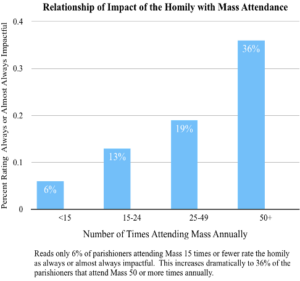
Certainly, for those who are regularly at Mass, one out of three is not as high a rating as we would like it to be. Bishops bemoan the stack of letters on their desks which complain about poor preaching. But it is even more clear that the words from the ambo are not connecting with those “in the back”. (See The Lord Hears the Cry of the Poor: Lament and Evangelization in the Institute’s Homiletic Scholar Series.) Young people grow disheartened when they hear (what they themselves call) the “same-old-same-old” (see the 2012 survey of Catholic teens in Connecting Pulpit and Pew, pg. 13).
Engagement in Parish Activities
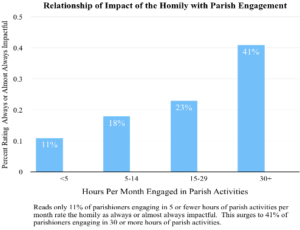
Parishioners who engage in parish activities more than 30 hours per month are four times more likely to rate their homilies highly than those who engage five or fewer hours per month. They are involved in prayer, Mass, retreats, young adult groups, bible studies, and more. A sign of parish flourishing is that young adults want to be there. Those who find the homily impactful are more likely to be at the parish.
Giving of Income
Young adults have never historically been the “big givers” in a parish. In our study, when asked what percentage of annual income they contribute, two thirds of them give ten percent or less.
But for young adult parishioners who are positively impacted by the homily, there is a significant difference in how much they put into the collection plate. It is striking: more than forty percent of those who rated the homily highly (a 6 or 7) say that they contribute 20% or more of their annual income to the parish. Another almost 23% give 10-20% of their annual income.
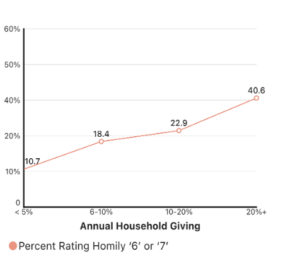
Though the preaching of the Gospel has never been proclaimed for its return on investment (ROI), this correlation would suggest that investment in the improvement of homilies might result in financially healthier balance sheets.
The Vision of Renewal
The Church is concerned about its outreach to youth and young adults and rightly so. Critiques of the homily abound and there is surely room for improvement. Yet we see a population of young adults who, with Pope Francis, have found that “the homily can actually be an intense and happy experience of the Spirit, a consoling encounter with God’s word, a constant source of renewal and growth” (Evangelii Gaudium #136). These young adults who hear effective homilies help their faith communities to flourish: they come to Mass, they are involved in their parishes and they contribute their income to the place that they have grown to love. Impactful homilies are a powerful part of parish health.